
Xi'an is our home base and the busiest westbound departure for Iran. Cargo exits via Khorgos or Alashankou, crosses Kazakhstan, and enters Iran either through the Turkmen borders (Sarakhs or Incheh Borun) or via the Aktau–Anzali Caspian service. It clears at Aprin dry port in Tehran. Block-train transit is 28–35 days door to door, and because we hold our own 6,000 m² warehouse in Xi'an, consolidation is under one roof.
Disruption in the Strait of Hormuz has pushed a large share of former ocean cargo onto land corridors, and China-Europe Railway Express volume is up at the same time. Block-train capacity is planned in advance, so slots and wagons are short on the Iran lanes. Lock space three to four weeks earlier than usual and keep a buffer on the delivery date. On an enquiry we state the current queue and the transit we expect on each corridor that week.
As an early operator on China-Europe rail, Xi'an is the widest-choice departure for Iran as well: the China-Europe timetable trains, the China-Russia trains and the Iran corridors all load here, and our own consolidation warehouse sits inside the terminal area. That matters on the Iran lanes specifically, because when space is tight the practical question is not only price but which departure actually has a slot.
The routing exits Xinjiang at Khorgos (or Alashankou), crosses Kazakhstan, and enters Iran one of three ways: the Aktau–Anzali Caspian service, the Sarakhs border, or Incheh Borun (paired with Akyayla / Etrek on the Turkmen side). Import clearance is completed at Aprin dry port in Tehran and cargo is distributed nationwide. The whole route avoids the Strait of Hormuz.
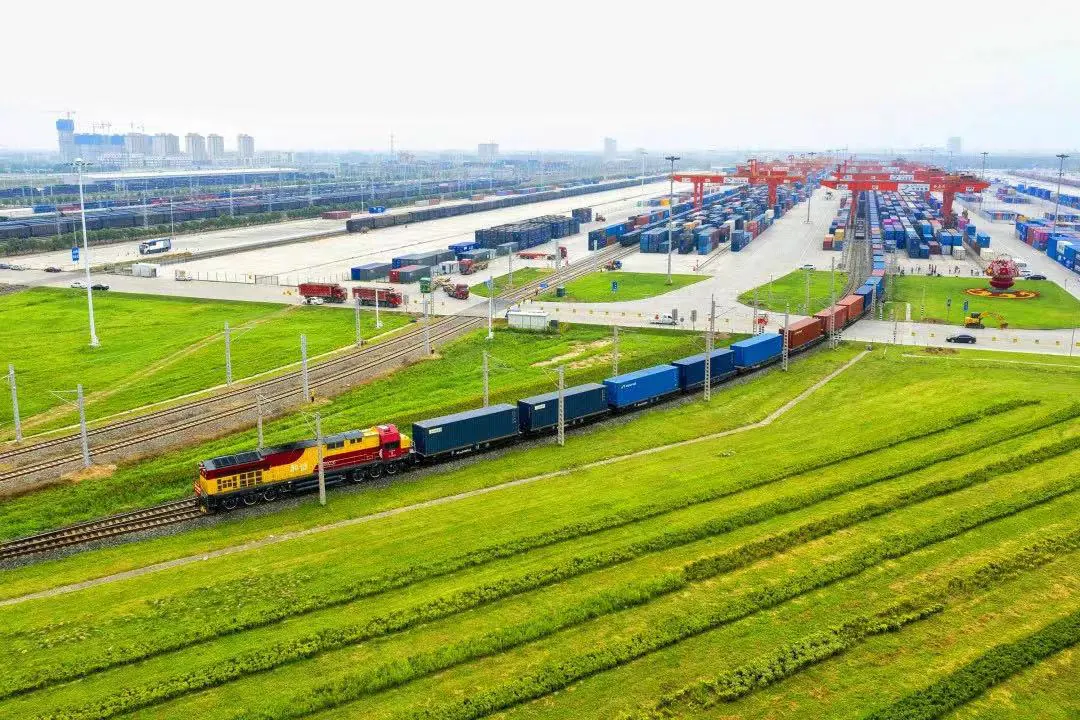
| Item | Detail |
|---|---|
| Lane | Xi'an → Tehran (Aprin dry port), Iran |
| Corridors | 1) Aktau–Anzali Caspian service 2) Sarakhs, Turkmenistan 3) Incheh Borun (Akyayla / Etrek) |
| Exit border | Mainly Khorgos; Alashankou as the alternative |
| Departure | Xi'an — own consolidation warehouse, widest corridor choice |
| Transit | 28–35 days door to door (moves with the border queue) |
| Gauge changes | Standard to broad gauge at the China–Kazakhstan border; broad to standard at the Turkmen–Iran border |
| Equipment | 20GP / 40GP / 40HQ; SOC containers can be arranged |
| Clearance | Import customs clearance at Aprin dry port, Tehran. DAP or DDP |
| Alternative | Part-loads: Xi'an to Tehran LCL |
From Xi'an you are not tied to one road. All three corridors are enquired at the same time, and you see availability and price side by side. When one border queues, having an alternative is the value.
Rail to Aktau in Kazakhstan, then the Caspian service to Anzali in Iran, and on by domestic transport to Tehran. The crossing is usually 24–48 hours.
Caspian service in detail →Through Kazakhstan and Turkmenistan, gauge change at Sarakhs on the Turkmen–Iran border, then by rail via Mashhad to Tehran. All rail, no sea leg.
Sarakhs in detail →Entry through Akyayla (Etrek) and Incheh Borun, then Iranian rail to Tehran. The relief valve when the Sarakhs queue is long.
Incheh Borun in detail →There is no standing "USD X per container" figure that holds while the corridor is constrained. The build-up is more useful than a single number.
| Cost item | What it covers | What moves it |
|---|---|---|
| Xi'an domestic leg | Pickup, stuffing and lashing, export declaration, terminal charges | Distance from origin to Xi'an; whether the cargo is heavy or fragile |
| Linehaul | Rail freight, transit charges and gauge-change handling | Equipment, how tight space is, and which corridor |
| Sea leg | Only on the Caspian corridor: port handling and a ferry or liner slot | Vessel supply and the queue on Aktau–Anzali |
| Container | COC hire, or the positioning and return cost of an SOC container | How long the box is out, and whether it returns elsewhere |
| Iran | Clearance fee, customs duty and VAT, inspection, final delivery | HS code and duty rate, DAP or DDP, and delivery distance |
Send the origin, the commodity, the volume, the equipment and the delivery address. What comes back is a rate breakdown that can be executed, not a round "how much".
Operating transit is 28–35 days door to door. The main variables are the departure schedule, the gauge-change queue at the Turkmen–Iran border and the vessel connection on the Caspian leg. We state the in-transit time we expect that week at booking, and recommend a buffer on the delivery date.
All three: the Aktau–Anzali Caspian service, Sarakhs, and Incheh Borun. They are enquired together and priced side by side. The live choice follows the commodity, the station and the space that week.
Yes — on a separate service. See Xi'an to Tehran LCL. Part-loads are consolidated in the Xi'an warehouse and charged by CBM or revenue tonne.
Yes. Under ordinary DAP the Iranian consignee clears and pays duty and tax. For DDP our partner broker files with IRICA, pays customs duty and VAT, and we complete final delivery. Fix the mode before booking — who clears and who pays is different.
20GP, 40GP and 40HQ as standard. Shipper-owned (SOC) containers can be arranged to limit demurrage and detention when the borders queue. Overweight and out-of-gauge cargo is assessed before booking.