
We are a China-based freight forwarder running the China to Iran railway: FCL boxes reach Aprin dry port in Tehran in 25–35 days, 25.5 t net per container, freight prepaid, DAP or DDP. Three corridors are priced together — Aktau–Anzali (Caspian), Sarakhs and Incheh Borun (Akyayla / Etrek) — with departures from Xi'an, Wuhan, Zhengzhou, Chengdu, Urumqi and Jinan chosen on space and price. With Hormuz disrupted, Persian Gulf ocean services are restricted and sea cargo has shifted onto land, so rail slots and wagons are tight.
Disruption in the Strait of Hormuz has led several liner operators to suspend or restrict Persian Gulf services, and a large share of former ocean cargo has moved onto land corridors. China-Europe Railway Express volume is also up sharply. Block-train capacity is planned in advance and cannot be expanded quickly, so both slots and wagons are short and some cargo is queueing at stations and ports.
Our advice: lock space early. Build a buffer into time-sensitive deliveries. Where it helps, split the move across corridors (the Caspian service plus the Turkmen–Iran borders) so one queue does not hold the whole shipment. On an enquiry we will state the current queue and the transit we expect on each corridor.
Rail from China to Iran exits at Khorgos (or Alashankou) in Xinjiang, crosses Kazakhstan, and enters Iran either via the Caspian or through a Turkmenistan–Iran rail border. Import customs clearance is completed at Aprin dry port in Tehran, and the cargo is then distributed across Iran. The routing avoids the Strait of Hormuz entirely. With ocean access constrained, it is one of the more stable overland choices from China to Iran.
The Iranian end is still being strengthened. Islamic Republic of Iran Railways has said publicly that Sarakhs and Incheh Borun together handle about 5 million tonnes and are planned to rise above 10 million tonnes. In 2025 Iran and Turkmenistan agreed to add one standard-gauge and one broad-gauge transfer line at Sarakhs, and the Turkmen side is adding freight wagons at the same time. Aprin dry port in Tehran has its own customs facility and bonded storage, designed for nearly 800,000 TEU a year, with five rail tracks. It is the main import-clearance hub for the Tehran area. Iran has also said that dry-port capacity at Aprin, Yazd, Kashan and Sarakhs needs to be brought into use, so cargo is not concentrated on the southern ports.
This needs to be said plainly: the market is not running on a theoretical transit. With the corridor congested and trains and wagons short, our actual transit is 25–35 days. We quote the in-transit time against the real queue that week. We do not use an ideal number to win the booking.
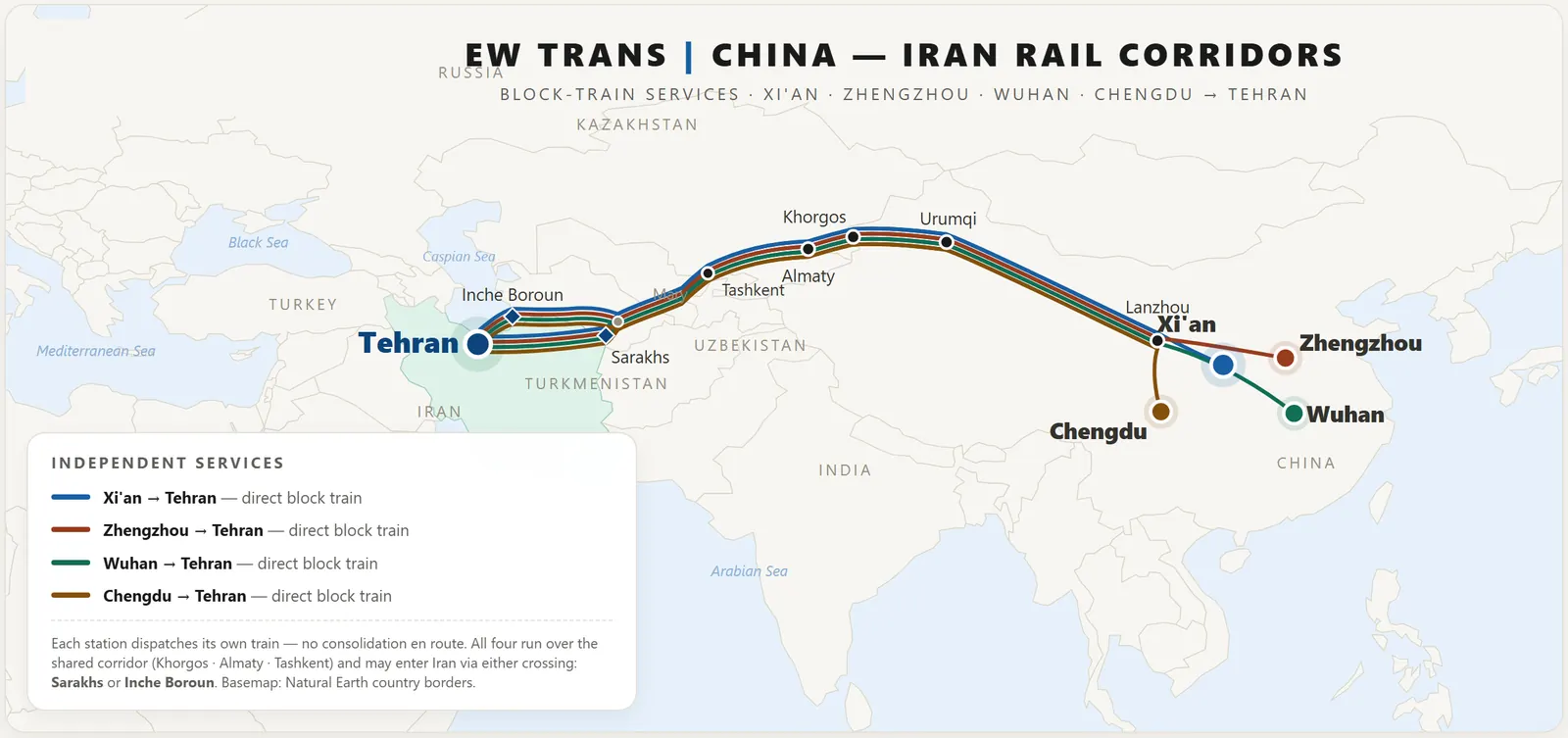
| Item | Detail |
|---|---|
| Destination | Aprin dry port, Tehran; nationwide distribution in Iran after clearance |
| Corridors | 1) Aktau–Anzali Caspian service 2) Sarakhs, Turkmenistan 3) Incheh Borun (Akyayla / Etrek) |
| Exit border | Mainly Khorgos; Alashankou as the alternative |
| Departure terminals | Xi'an, Wuhan, Zhengzhou, Chengdu, Urumqi, Jinan (best of six on space and price) |
| Transit | 25–35 days (current operating transit; it moves with the queue) |
| Gauge changes | Standard to broad gauge at the China–Kazakhstan border; broad to standard gauge at the Turkmen–Iran border (Kazakhstan and Turkmenistan are both broad gauge, so no change between them) |
| Equipment | 20GP / 40GP / 40HQ; shipper-owned (SOC) containers can be arranged to limit demurrage and detention |
| Clearance | Import customs clearance at Aprin dry port, Tehran. DAP (consignee clears) or DDP (we clear both ends, duties and taxes included) |
| Scope | Domestic trucking, stuffing and lashing, export customs declaration, block-train booking, tracking, gauge-change coordination, Iranian clearance and final delivery |
Iran has never been a single road to the end. Each corridor fits a different job, and which one is moving and which one is priced reasonably that week is shown in the same enquiry. We do not quote one option and leave you without a choice. Each corridor has its own page.
Rail to Aktau in Kazakhstan, then the Caspian service to Anzali in Iran, and on by domestic transport to Tehran. Aktau and Anzali have regular ro-ro and container sailings. The crossing is usually 24–48 hours.
Fits cargo for northern Iran, or cargo that needs to be distributed through a Caspian port.
Caspian service in detail →Through Kazakhstan and Turkmenistan, gauge change from broad to standard gauge at Sarakhs on the Turkmen–Iran border, then by rail via Mashhad to Tehran. All rail, with no sea leg.
Fits cargo that wants one fewer handling, or that should not depend on a Caspian sailing.
Sarakhs in detail →Entry through Akyayla (Etrek) in western Turkmenistan and Incheh Borun on the Iranian side, then Iranian rail to Tehran. Like Sarakhs, it is a main-line rail border between Turkmenistan and Iran, and it is the relief valve when the other border queues.
Fits cargo that needs to be diverted when the Sarakhs queue is long.
Incheh Borun in detail →Availability, queue time and price on all three move with the borders. State the commodity, the volume and the final delivery address when you enquire, and we will recommend the combination that works that week.
When space is tight, loading nearby is not only cheaper. It is also how you are more likely to get a slot. Each of the six terminals has its own schedule and its own cargo base. The plan follows your origin, the space that week and the price.
| Terminal | Main exit | What it offers | Origins served |
|---|---|---|---|
| Xi'an | Khorgos / Alashankou | The main westbound China-Europe hub, with the fullest west-corridor coverage | Northwest and central China, plus nationwide consolidation |
| Wuhan | Khorgos | Departures rose sharply after ocean access was constrained; strong central consolidation | Central and east China, and cargo moved to Wuhan by inland waterway |
| Zhengzhou | Khorgos / Alashankou | A stable schedule and a mature Central Plains cargo base | Central China, north China and the Central Plains |
| Chengdu | Khorgos / Alashankou | The main southwest terminal, linked to Chengdu-Chongqing cargo | Southwest China and the Chengdu-Chongqing region |
| Urumqi | Khorgos / Alashankou | Closest to the exit border, so the domestic leg is the shortest | Xinjiang and northwest China; suited to urgent departures |
| Jinan | Khorgos / Alashankou | Covers the Yellow River industrial belt in Shandong, with a strong cargo base | North China, east China and the Shandong Peninsula |
Live schedules and pricing are confirmed at the time. If your origin is not one of these cities, we will assess the best departure and how the cargo should be consolidated.
Split into legs, it is clear where the money goes and where the time goes. The Sarakhs version is below. The Caspian version is on that corridor's page.
| Commodity | What to plan for |
|---|---|
| Machinery and industrial parts | Load to the centre of gravity and the lifting points. Overweight and out-of-gauge pieces need flat-rack, open-top or a rail flat assessed. Confirm whether a pre-shipment inspection is required |
| Building materials (tiles, sanitaryware, pipe) | Tiles and sanitaryware are fragile: timber pallets, corner protection and layers separated. Pipe and steel are heavy and need a per-container weight calculation, or the border will order a restuff |
| PV and electrical equipment | Modules are fragile and high value. Moisture-protected pallets, a stack-height limit and securing against shift, plus loading photos kept as the claim file |
| Auto parts | Confirm weight distribution and stacking by part. Precision parts need shock protection. Wood packaging must meet ISPM 15 |
| Appliances and consumer goods | FCL or LCL consolidation. Carton strength and stack height matter, or repeated gauge changes collapse the outer pack |
The list is the commodities we see most often. If the product is dangerous goods, contains batteries, is controlled, or sits under any other special regime, give us the description and the HS code with the enquiry. We confirm it can move before we price it.
There is no standing answer to what one container from China to Iran costs — least of all while the corridor is constrained and rates are moving faster than usual. The build-up is more useful than a single number.
| Cost item | What it covers | What moves it |
|---|---|---|
| Domestic leg | Pickup, stuffing and lashing, export declaration, terminal charges | Distance from origin to the departure terminal; whether the cargo is heavy or fragile |
| Linehaul | Rail freight, transit charges and gauge-change handling | Departure city, equipment, how tight space is, and which corridor |
| Sea leg | Only on the Caspian corridor: port handling and ferry or liner slot | Vessel supply and the queue on Aktau–Anzali |
| Container cost | COC container hire, or the positioning and return cost of an SOC container | How long the box is out, and whether it has to be returned elsewhere |
| Iran | Clearance fee, customs duty and VAT, inspection, final delivery | HS code and duty rate, DAP or DDP, and the delivery distance |
| Insurance | Door-to-door cargo insurance | Cargo value, and whether war risk or other special clauses are added |
Two points matter more than the rest. First, a figure quoted online as "USD X per container" is usually a normal-market reference, and it has limited use while the corridor is constrained. The price that can actually be booked is the price on the day of booking. Second, comparing freight and ignoring the container is a common mistake. When borders queue and clearance takes longer, demurrage and detention can cost more than the freight difference. That is why we often place shippers on SOC containers.
Send the origin, the commodity, the volume, the equipment and the final delivery address. What you get back is a rate breakdown that can be executed, not a round "how much".
FCL is not LCL with a bigger box. On a full container, the entire risk of that shipment rides on one unit — which box you pick, how much weight it carries, whether the cargo is admissible on rail, whether there is space on the train, and who pays when something goes wrong. These six checks are where shipments actually get stuck at the border. They are also the first things we ask when someone requests a full container rate.
A 40GP and a 40HQ are the same length. The difference is height. Light, bulky cargo goes in the high cube; dense cargo goes in a 20ft — and that is decided by which ceiling you hit first, weight or volume, not by saving money on the box. The next section gives the breakpoints.
| Type | Internal dimensions (L × W × H) | Capacity | Practical loadable volume | Typical cargo |
|---|---|---|---|---|
| 20GP | 5.90 × 2.35 × 2.39 m | 33.2 cbm | 28–30 cbm | Dense cargo, machinery, metal products, building materials |
| 40GP | 12.03 × 2.35 × 2.39 m | 67.7 cbm | 58–60 cbm | General goods, cartons, mixed consignments |
| 40HQ | 12.03 × 2.35 × 2.69 m | 76.4 cbm | 66–68 cbm | Light bulky cargo, textiles, plastics, furniture |
"Practical loadable volume" already accounts for what filling a box actually costs you: gaps between cartons, pallet footprints, and the space you must leave clear at the doors. Nominal capacity assumes a perfect cube. Reaching 88–92% is a good load. But keep the two limits separate: the box type decides how much volume you can load, not how many tonnes. Tonnage has its own cap.
Start with the number most people get wrong: on this corridor a container may carry no more than 25.5 tonnes of cargo, and that figure is the same for a 20ft and a 40ft. It is cargo payload — the tare weight of the box is on top of it.
The obvious question is why a 40ft does not take more. It is not about the strength of the box. It is about wagon axle load and what the gauge-change terminal can physically handle. The China–Iran train crosses Kazakhstan and Turkmenistan on 1,520 mm broad gauge, where axle limits are tighter than on standard gauge. A 40ft box is long and puts its weight near the two ends, which leaves less tolerance for uneven distribution on the wagon during gauge change, lifting and stacking. The same 25.5 tonnes occupies a longer stretch of deck in a 40ft, so the error margin is actually smaller, not larger.
Overweight is not a fine you absorb and move on. When the box is found heavy at the gauge-change terminal, the usual instruction is to devan the cargo on the spot and reload it. The labour, storage and demurrage fall on the cargo owner, and two to three weeks of delay on a single shipment is common. Worse, the slot is already spent — the box waits for the next departure. So tonnage is settled at quotation, not at the weighbridge:
| Stage | What gets confirmed | By whom |
|---|---|---|
| Enquiry | Commodity, package count, unit weight, total gross weight, whether it can be split | Shipper provides; we size the container and the box count |
| Booking | Payload cap in force for that departure; wagon availability | We confirm with the train operator and put it in writing |
| Loading | Weighed weight against declared weight; load centred | Warehouse weighs and issues a weight ticket |
| Transshipment | Re-weigh result; whether splitting or re-stowing is required | Our border agent attends on site |
25.5 tonnes is the ceiling, but whether you can actually reach it depends on cargo density. Taking a practical load of 29 cbm for a 20GP and 67 cbm for a 40HQ, cargo falls into three bands:
| Cargo density | Which limit you hit first | What to book |
|---|---|---|
| Under 0.38 t/cbm | Volume: a full 40HQ at 67 cbm weighs about 25 tonnes | 40HQ — the weight cap barely binds |
| 0.38–0.88 t/cbm | Weight first in a 40HQ; volume first in a 20GP | Usually 40HQ: one box reaches 25.5 tonnes; 20fts multiply your container count |
| Over 0.88 t/cbm | Weight: a 20GP hits 25.5 tonnes just as the cube fills | 20GP — a 40HQ wastes close to half its volume on this cargo |
Machinery, metal products and building materials usually sit above 0.88 and belong in a 20ft. Textiles, plastics and furniture sit below 0.38 and only work in a high cube. The middle band is where quotes go wrong — if you are not sure which side your cargo falls on, send the gross weight and package count and we will back-calculate the box count against 25.5 tonnes.
This is where rail differs most from ocean freight: there is no schedule to look up. Departures on this corridor are not laid out on a fixed cycle — many are put together at short notice. One is confirmed; when the next appears, nobody can say in advance. Some months are dense, others thin. So no "sails every Tuesday" claim holds here, and we do not make one.
Two things are certain: cut-off falls three days before dispatch, and capacity on any given departure is limited and hard to get. Short-notice departures add a twist — the gap between a departure being released and its dispatch is sometimes shorter than three days. Start organising cargo once the news lands and you have usually missed that train.
What that really means is simple: whoever hears first and has cargo ready first, ships. Our way of working follows from it:
First, have the cargo ready before a departure is confirmed, not after. Packed, documented, standing by — so a departure can be stuffed the moment it appears. On this corridor it is the only variable you actually control, which is why we keep coming back to it.
Second, we watch the departures, you watch production. Knowing what is bookable and which departure still has space is our job. When one opens you hear from us, with the cut-off, stuffing date and expected dispatch attached — you should not have to chase it.
Third, space is a scheduling problem, not a price problem. A rate you agree on is worthless without a slot, and a rate means something only once the slot is locked. That is why we confirm space first and issue the formal quotation second.
Fourth, lock space before you load. Do not pull cargo into a warehouse while the slot is unconfirmed. Storage while a box waits for space is the most common avoidable cost on FCL, and it lands hardest on shipments that are already urgent. If your cargo carries a hard deadline, budget one whole departure of slack — on an irregular timetable, slack is counted in departures, not days.
A question that comes up on almost every enquiry: who handles the cargo on the Iranian side? The answer differs train by train — each departure names its own terminal, agent and handover procedure on the Iran end, and that arrangement is fixed by the train operator. You do not need to source an Iranian agent yourself. Once the booking is confirmed, we put the contact handling your departure in writing, and from origin to final delivery you deal with one counterpart: us.
Freight on this corridor is settled in full before departure, once the booking is confirmed. We do not work on payment at destination. Currency and invoicing follow the contract and are stated on the formal quotation.
On price we do not quote a range. Rates on this lane move enough that a range stops being information — a figure from three months ago can neither book a slot nor benchmark a competitor today, and it only misleads your budget. What we quote is the current firm rate for a specific departure, with a stated validity, normally up to that train's cut-off. If you are budgeting a quarter ahead, we will give you the basis available for your planned month and mark exactly which sailing period it applies to.
Rail dangerous goods rules (SMGS and the national rail regulations along the route) do not match IMDG at sea or ADR on the road. Cargo that travels fine by truck may be refused on rail. In practice we split enquiries into three groups:
| Category | Typical cargo | What we need |
|---|---|---|
| Accepted | Non-hazardous chemicals, plastic raw materials, non-flammable coatings, household chemicals | Commodity name and HS code; a non-DG certificate where relevant |
| Assessed case by case | Lithium batteries and battery-containing goods (UN3480 / UN3481 / UN3520), alcohol-based products, some adhesives and solvents | Full 16-section MSDS, UN number, DG packaging certificate, rail transport suitability report |
| Not carried | Explosives, toxic gases, radioactive material, strongly corrosive chemicals, and anything banned by the rail regulations of the countries on the route | — |
A warning worth repeating: battery-containing cargo is the most common mistake in FCL bookings. Declared as general cargo, a box that gets scanned or opened at the border takes the whole consignment back to square one — and with no published timetable, back to square one means waiting for the next departure, not a week. Telling us there is a battery up front costs you a suitability check; discovering it at the border costs you the departure.
On insurance, FCL cargo is normally covered on an all-risks door-to-door basis (ICC-A), insured for 110% of cargo value and bound before loading. Where the routing crosses the Caspian leg or a transit segment under current conditions, war risk can be added — the rate is assessed against cargo value and the situation at the time, so it is quoted rather than fixed. Note the usual exclusions: inadequate packing, inherent vice and ordinary loss in transit are not covered. Cartons that take on water, or crates without fumigation, fall outside the policy.
On lashing, a full container is handled more often than a pallet: gauge change, lifting, yard storage, and a road leg at the far end. The shock load inside the box is higher than on an all-water route. Three baselines: keep the centre of gravity within ±10% of the box centre, never put heavy over light or large over small, and design the securing for machinery against its lifting points and centre of gravity (timber blocking, steel strapping, airbags). The box is devanned again at Aprin dry port before final delivery, so the securing plan has to survive two handling cycles, not one.
Settle these six and you know your container type, your payload, whether the cargo is admissible, whether you have space, how it is paid for, and how the risk is covered. Send them together — commodity, gross weight, package count, origin and the month you want to ship — and what comes back is a booking that can actually be made, not just a number.
Related pages: Xi'an to Tehran FCL | Zhengzhou to Tehran | Chengdu to Tehran | Wuhan to Tehran | Iran DDP, duty paid | Sarakhs border | Incheh Borun border | Aktau–Anzali across the Caspian | Is there a railway from China to Iran? | Enquire by container type
| Step | What it means |
|---|---|
| Where clearance happens | The border does an entry pre-check only. Formal import clearance is at Aprin dry port in Tehran, which has its own customs facility |
| DAP or DDP | DAP: the consignee clears and pays duty and tax. DDP: our partner broker files with IRICA and pays customs duty and VAT, then we deliver |
| Core documents | Commercial invoice, packing list, SMGS international rail consignment note, certificate of origin (which can reduce part of the duty). Some goods need a pre-shipment inspection certificate |
| Wood packaging | Must meet ISPM 15 and carry a clear IPPC mark. This is one of the items most often checked when a box is opened at random |
| What inspectors look at | Lashing and cargo securing, whether the documents match the goods, wood-packaging compliance, and whether the seal is intact |
| Why boxes are held | A wrong HS code, a missing certificate of origin or an incomplete invoice all trigger a customs review and a physical exam. Storage and detention that follow are for the cargo owner's account |
| Clearance time | Normally 2–7 days. An exam or missing papers extend it. Build that into the delivery plan |
This is a process note. Controls, duty and quarantine follow current Iranian rules and the goods on the file.
Importing from China to Iran by rail takes 25–35 days station-to-station and 28–40 days door-to-door, and the work splits into three roles: the Chinese side handles pickup, export declaration and the rail leg; the Iranian consignee holds the import permit (ثبت سفارش) and the VÖEN tax number; the customs broker files the declaration at Aprin dry port. Knowing which role owns which paper is what keeps a shipment moving.
| Stage | Who owns it | What actually gets done |
|---|---|---|
| Pickup and export | The China side (us) | Nationwide pickup to the Xi'an consolidation warehouse, export customs declaration, loading and securing, rail booking |
| Rail transit | The carrier (us) | Corridor selection among Sarakhs, Incheh Borun and Aktau–Anzali, transshipment tracking, arrival at Aprin dry port |
| Import permit (ثبت سفارش) | The Iranian consignee | Registration must be in the consignee's name with quota available — this is done before the goods arrive |
| VÖEN tax number | The Iranian consignee | Without it no declaration can even be created in the IRICA system |
| Import clearance | Broker, per terms | DAP: the consignee's broker clears and pays. DDP: our partner broker files, pays duty and VAT, then delivers |
| Inland delivery | The Iran side (us) | From Aprin to Tehran addresses and other cities, after release |
If you are buying from Chinese suppliers and want one counterparty for the whole chain, ask for DDP: we file and pay duty and VAT in Iran and deliver to the door, while the permit and VÖEN stay in your name — that division is fixed by Iranian rules, not by us.
A first move to Iran usually arrives buried in abbreviations and border names. These are the ones that actually come up.
When the corridor is tight, the failure is usually preparation, not the train itself. Each of the following is happening often right now.
The first line of most enquiries we receive is some version of "our factory is in Ningbo, not Xi'an — can you still ship?" Yes. And the routing depends less on distance than on which terminal has space in the week you ship.
| Where the cargo sits | How it boards | Who handles the domestic leg |
|---|---|---|
| Shanghai, Ningbo, Zhangjiagang, Changzhou, Zhongshan | Stuffed at Wuhan, Zhengzhou or Jinan, or trucked into the Xi'an consolidation warehouse first — whichever has the space and the better rate | Trucking, warehouse receiving, shunting to the terminal, stuffing and lashing, one desk and one thread |
| Changsha, Wuhan, Zhengzhou | Loaded at the central terminal directly, with no detour to Xi'an | Short haul to the terminal plus export declaration, then it waits for the block train |
| Tianjin, Qingdao | Rail west via Khorgos or Alashankou, or ocean to Bandar Abbas — we price both against your deadline | Port storage, export declaration and collection |
Four things is all we need: origin city, commodity (and whether it is battery-powered or regulated), rough volume or weight, and the delivery address in Iran. Domestic and rail legs are quoted separately, so you can see what each part costs instead of one figure with pickup buried inside.
The 25–35 day figure runs from loading at the departure terminal. Pickup and consolidation happen before that and are confirmed per city; urgent cargo can be loaded the day it reaches the warehouse if it makes the train's cutoff.
We take cargo from any city in China. The four pages below cover the origins that generate most of our Iran bookings, because the domestic leg, the commodity mix and the paperwork differ from place to place — a battery maker in Changsha and a lighting exporter in Zhongshan do not have the same problems. If your city is not listed, it is still covered: tell us the pickup address and we quote the domestic leg with the rail rate.
Several liner operators have suspended or restricted Persian Gulf services because of the disruption. Ocean space is hard to get, and both risk and cost are clearly higher. Some cargo has had to discharge at outer ports such as those in Oman and move on from there. That shift onto rail is the direct reason rail space is tight.
With the corridor congested and trains and wagons short, operating transit is 25–35 days. The main variables are the departure schedule, the gauge-change queue and the vessel connection on the Caspian leg. At booking we state the in-transit time we expect that week, and we recommend a buffer on the delivery date.
Disruption in the Strait of Hormuz has made China–Iran rates move sharply. Most numbers circulating in the market are normal-period references. The price that can be booked has to be confirmed live. The main drivers are the departure city, equipment, whether the goods are dangerous or controlled, whether an SOC container is required, and how tight space is. Send the commodity, the volume and the delivery address and we will give a rate that can be executed that week.
The Aktau–Anzali Caspian service fits cargo that needs a Caspian port for distribution, or a destination in northern Iran. Sarakhs is the principal rail border in northeast Iran: all rail, no sea leg. Incheh Borun, paired with Akyayla / Etrek on the Turkmen side, is the other Turkmen–Iran rail border and is used to divert volume. The live choice follows the commodity, the station and the space that week. One enquiry produces all three.
After traffic through the Strait of Hormuz was disrupted, Persian Gulf ocean cargo moved onto land in volume, while China-Europe Railway Express traffic was also rising. Block-train capacity is planned in advance and cannot be expanded quickly, so slots and wagons are both short and cargo queues at stations and ports. Book early, or split the move across corridors.
Sarakhs and the other borders do an entry pre-check and the gauge change. Formal import clearance is at Aprin dry port in Tehran. Aprin is about 21 km from Tehran, with its own customs facility and bonded storage. After release, trucks distribute across Iran.
Yes. Under ordinary DAP the Iranian consignee clears and pays duty and tax. If you need DDP, our partner broker in Iran files with IRICA, pays customs duty and VAT, and we complete final delivery. Which mode applies should be fixed before booking, because clearance responsibility and who pays are different.
Wood packaging must meet ISPM 15 and carry a clear IPPC mark. This is one of the items most often checked when Sarakhs opens a box at random. Documents normally include a commercial invoice, packing list, SMGS international rail consignment note and a certificate of origin. Some goods also need a pre-shipment inspection certificate. We provide a document checklist before departure.
SOC means a shipper-owned container. On the China–Iran rail corridor an SOC container avoids carrier or container-owner demurrage and detention. That matters when gauge-change queues and clearance run long. We can arrange SOC equipment and show the cost against COC.
In the current situation, insure door to door and be explicit about war risk and sanctions-related clauses. Do not assume an ordinary all-risks policy includes war. Keep the loading photos. They are the core evidence if the cargo is damaged.
Yes. Inside Tehran, usually the same day. Other cities are about 1–3 days depending on distance. Aprin dry port connects to the Iranian domestic rail network and can also hand over to truck. We price the final leg against your delivery address in the enquiry.
Ordinary chemicals can usually move if a safety assessment is provided. Lithium batteries, other battery products and dangerous goods have to be confirmed separately before booking, with an MSDS and a transport-conditions report. Rail and the borders examine dangerous goods closely. Send the description and the HS code first. We confirm it can move, and only then arrange the departure.
Chinese rail is 1,435 mm standard gauge. Kazakhstan and Turkmenistan are 1,520 mm broad gauge. Iran returns to standard gauge, so the move needs two gauge changes. The container is lifted onto a wagon of the other gauge. It is routine work, but it is an extra lift and an extra shock. Pack strength, internal lashing and the stowage plan have to be designed for repeated lifts.
The traditional peaks are around Chinese New Year, around Nowruz in March, and the fourth quarter. Slots and wagons are hardest to find then. With the corridor constrained as it is now, book three to four weeks earlier than usual, and keep a buffer on the delivery date.
Yes, the same. Cargo net weight is capped at 25.5 tonnes per box for both 20GP and 40HQ, excluding tare weight. A 40-footer does not carry more weight than a 20-footer on this corridor — that is not box strength but wagon axle load and transhipment conditions at the border. Overweight cargo is devanned at the border and reloaded, at the shipper's cost and delay. Give us accurate net weight and package count before booking.
It depends on density, not on how heavy the cargo feels. Below 0.38 t/CBM take a 40HQ — volume runs out first. Between 0.38 and 0.88 t/CBM a 40HQ is usually cheaper, because one box can reach the full 25.5 tonnes. Above 0.88 t/CBM take a 20GP, since a 40-footer at 25.5 tonnes still has nearly half its volume empty — you pay for air. The common mistake is assuming heavy cargo always needs a 20-footer.
FCL freight to Iran is prepaid in full — settled after booking confirmation and before dispatch. We do not offer payment on arrival or balance-at-destination terms. We also do not quote rate ranges: on this corridor current rates move too much for a range to mean anything. What you get is the current firm rate with a validity date tied to that departure's cut-off. Customers budgeting by quarter get an indicative level for the planned month.
There is no fixed timetable, and no "sails every Tuesday" rhythm — many departures are assembled at short notice, dense one month and thin the next. What is fixed is that cut-off falls three days before dispatch, while short-notice departures sometimes leave less than three days between release and dispatch. So the right move is to have cargo packed and documents complete, standing by — ready to stuff the moment a departure appears. Starting to organise cargo after the news lands usually means missing that train. Watching departures is our job; you just tell us the target month and the cargo-ready date.
You do not need to source an Iranian agent. The terminal, agent and handover procedure on the Iran side are designated by the train operator and differ departure by departure; once the booking is confirmed we give you the contact for your departure in writing. From dispatch to devanning and delivery you deal with one counterpart: us. Onward delivery beyond Tehran — Isfahan, Shiraz, Mashhad, Tabriz — can be arranged in the same booking.
Get the order of operations right: space is a scheduling problem, not a price problem. A rate you agree on is worthless without a slot, and a rate only means something once the slot is locked — so we confirm space first and issue the formal quotation second. Also do not pull cargo into a warehouse before the slot is confirmed; storage while a box waits for space is the most common avoidable cost on FCL. For a hard deadline, budget one full departure of slack, not a few days.
No. Cargo can be stuffed at Wuhan, Zhengzhou or Jinan, or consolidated in Xi'an first; we compare both against the space available on the next departures. Rail transit is 25–35 days station-to-station either way. What changes is the domestic cost and the days you need before cutoff.
It sits before them. The clock starts when the container is loaded at the departure terminal. What decides whether you make a given train is the cutoff, which falls three days before departure, so the earlier the cargo is ready, the more departures you can choose from.
Yes. Send commodity, volume, weight and whether it stacks, and we recommend the box from the cargo density. FCL on this lane is capped at 25.5 tonnes net per container, identical for 20ft and 40ft. LCL is charged on the greater of cubic metres and weight divided by 500 kg.
Different bases. 13-18 days usually measures train running time - the fastest terminal-to-terminal runs into Iran - excluding factory pickup, waiting for a slot, border gauge-transfer queues, and clearance and distribution after arrival. Those are exactly the variable parts. Our 25-35 days is the realistic station-to-station range including border queues, and door-to-door runs 28-40 days. Plan against door-to-door; we confirm the current queue for your batch in writing.
Transit times, train schedules and charging rules on this page were last verified on 2026-11-14. Figures are indicative; the rate we confirm in writing governs.
Origin and email are enough - the rest can follow later. We reply in writing so you keep everything on record.