
Rail freight is no longer the backup option on the China to Iran lane. Since the railway corridor through Kazakhstan and Turkmenistan settled into a regular, bookable service, a growing share of Iranian imports — machinery, auto parts, electronics, building materials and consumer goods — moves by block train instead of waiting on a vessel. Sending cargo from China to Iran by train has turned from a one-off charter into a weekly routine. This guide sets out what the route really looks like in 2026: how long each stage takes, what the freight rate is built from, which documents the cargo needs, and how a freight forwarder turns a container into a firm door-to-door price.
1. Why importers moved onto the rail lane
The commercial case is simple. Ocean freight from China to Iran needs 30 to 40 days door to door, and on top of the sailing time the consignee absorbs war-risk surcharges, congested port queues and, in bad months, the risk that a sailing is postponed altogether. A rail departure is a fixed weekly slot: cargo leaves the same station on the same day of the week and lands in a predictable window. Fifteen to twenty days is the normal span, and the container is handed over at the Aprin dry port near Tehran rather than at a Gulf port a further 1,500 kilometres from the final warehouse.
That last point is often the deciding one. For importers whose customers sit in Tehran, Isfahan, Mashhad or Tabriz, rail removes an inland leg that sea freight cannot avoid. The full overview of the service sits on the China to Iran rail freight page.
2. The route, station by station
The railway route on this lane is fixed, and each box is first consolidated at a Chinese rail hub — Xi-an, Yiwu, Zhengzhou, Chengdu, Chongqing and Changsha are the usual origins — and lifted onto the train at the departure station. From there the run is:
- China exit: Khorgos or Alashankou on the Xinjiang border, where the box crosses into Kazakhstan.
- Gauge change one: the Chinese standard gauge of 1,435 mm meets the 1,520 mm broad gauge used across Central Asia. Containers are transshipped or bogies are exchanged.
- Transit: Kazakhstan, then Turkmenistan, on a through rail waybill.
- Iran entry: Sarakhs in the north east, the main rail gateway, or Incheh Borun further west depending on the routing and the border situation.
- Gauge change two: back onto Iran standard gauge for the domestic run to the terminal.
- Destination: Aprin dry port near Tehran, with onward domestic rail or truck delivery to other cities.
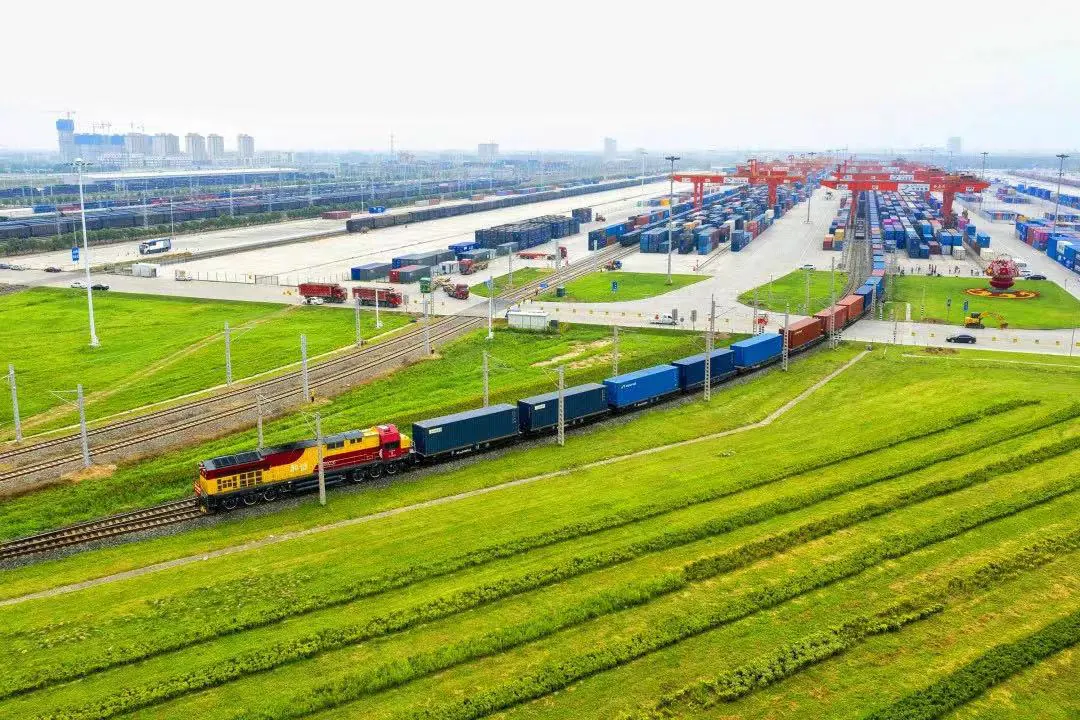
Total distance is a little over 10,000 kilometres. In the trade press the whole chain is often called the China Iran railway or the China Iran rail line; operationally it is three separate rail systems joined by two gauge changes. It also forms the southern arm of the middle corridor, the rail network that links China to Europe and the Gulf without crossing Russia. Two technical details matter more than anything else to the timetable, and both are explained in more depth on the China Iran railway page and on the Sarakhs border crossing page.
3. Transit time, stage by stage
Any single number you are quoted is an ideal case. The honest way to read a transit time is to look at the six stages that make it up, because each has its own queue logic.
| Stage | When smooth | When congested | Main variable |
|---|---|---|---|
| Consolidation and departure-station schedule | 3 to 6 days | 10 days or more | Weekly train density, distance to the station, whether a full box is ready |
| China exit border handling | 1 to 3 days | 5 days or more | Border traffic, inspection, completeness of documents |
| First gauge change | 1 to 2 days | 3 to 4 days | Availability of transshipment tracks and cranes |
| Transit through Kazakhstan and Turkmenistan | 5 to 7 days | 10 days or more | Through-train slots and transit declarations |
| Iran entry and second gauge change | 1 to 3 days | 5 days or more | Border queue at Sarakhs or Incheh Borun |
| Aprin terminal, clearance and delivery | 2 to 4 days | 7 days or more | Customs review, duty payment, inland trucking |
The practical conclusion: a container that is loaded and released early in a smooth week can be in Tehran in about fifteen days. The same container in a heavy border month will sit nearer twenty-five. When you plan a delivery date, budget the upper bound, not the average.
4. Rail against sea and road
| Mode | Typical door-to-door transit | Cost position | Best for |
|---|---|---|---|
| Rail, full container | 15 to 25 days | Mid, above sea, well below air | Machinery, auto parts, electronics, mid-size to large lots with a firm delivery date |
| Sea to Bandar Abbas | 30 to 40 days plus inland | Lowest per container | Bulk, low-value and non-urgent cargo |
| Road and TIR | 15 to 20 days | Above rail | Urgent lots and destinations not served by rail |
Most importers end up using two modes at once: rail for the regular programme, sea for anything that can wait. The comparison is set out in more detail on the Trans-Caspian corridor and China to Iran sea freight pages. Where the destination is inland and the cargo is time-sensitive, road freight China to Iran is the third option worth pricing.
5. FCL or LCL: full container and groupage
Almost all rail traffic on this lane is FCL, a full container load. The two standard units are the 20ft container, a general purpose box of around 28 cubic metres, and the 40ft container in high cube form, around 68 cubic metres. A 40ft high cube is the cheaper unit per cubic metre and the default choice for light, bulky goods; the 20ft box is preferred for dense cargo where weight, not volume, fills the container.
For consignments under roughly 15 cubic metres, LCL is the better answer. Under LCL, or groupage, your cargo shares a container with other shippers and you pay per cubic metre. LCL is slower, because the box cannot leave until it is full, but it turns a small order into a workable shipment. Our LCL groupage service from Xi-an to Tehran covers this option.
6. What the freight rate is built from
There is no single tariff on this lane. A rate is assembled from the following, and two quotes can differ by a wide margin simply because they cover different things:
- Origin: which Chinese station you ship from, and whether the cargo is collected from a factory or delivered to the terminal.
- Equipment: 20GP, 40HQ, or a special unit.
- Cargo: commodity, weight, whether the goods are classified as dangerous, and whether they need temperature control.
- Season: space tightens sharply before the Chinese New Year holiday and before Nowruz, and rates follow.
- Destination scope: terminal to terminal, or all the way to a warehouse with duties paid.
To receive a firm price rather than an indicative one, send us the commodity with its HS code, the volume in cubic metres and the gross weight, the pick-up city in China, the delivery address in Iran, and the date the goods will be ready. The quote request page takes this in one pass.
7. Documents and customs clearance in Iran
The document set on this lane is short but unforgiving. It normally contains the commercial invoice, the packing list, the rail waybill, a certificate of origin, and an insurance certificate. Certain product groups additionally need import registration or a compliance certificate before the goods may enter the Iranian market, and the customs classification determines the duty and tax position.
Two rules save the most time. First, every document must agree with every other one on the consignee name, the goods description and the HS code; a single mismatch is enough to hold a container at the border. Second, clearance should be prepared before arrival rather than after, so the broker can submit as soon as the waybill is released. Where a shipment contains batteries, chemicals or other regulated items, the classification question has to be settled before booking, not after.
8. Door to door and DDP terms
Terminal-to-terminal pricing leaves the consignee to organise clearance, duty payment and inland trucking. Many importers prefer to hand over the whole chain: collection at the Chinese factory, export declaration, the rail leg, Iranian import clearance, payment of duties and taxes, and delivery to the final address. That is what a delivered-duty-paid arrangement covers.
The difference between DDP and DAP sits entirely in the tax line: under DDP the seller carries the duty and the import tax, under DAP the buyer does. Because the two are frequently confused in quotation, it is worth deciding which one you want before the price is fixed. The Iran DDP service page explains the boundary in detail.
9. How to book
Booking is handled end to end by one freight forwarder, so you deal with a single party from factory collection in China to delivery inside Iran. The steps are:
- Send the cargo details and we return a rate with the transit window and the routing.
- Confirm the booking; we issue the space confirmation and a packing instruction.
- Cargo is collected or delivered to the station, and the export declaration is filed.
- The container is loaded on the next scheduled departure and the waybill is issued.
- We track the box across the two borders and report each handover.
- On arrival, clearance is filed, duties are settled and the cargo is delivered.
10. Frequently asked questions
How long does rail freight from China to Iran take?
Between fifteen and twenty-five days door to door in most months. The spread comes from border queues and departure-station schedule density rather than from the rail running time itself.
How much does a container cost?
It depends on the origin station, the container type, the season and how much of the destination side is included. A terminal-to-terminal rate and a delivered-duty-paid rate are not comparable figures, so always compare quotes on the same scope.
Which Chinese cities can ship to Iran?
Xi-an, Yiwu, Zhengzhou, Chengdu, Chongqing and Changsha are the established origins. Cargo from other provinces is moved to one of these hubs by domestic rail or truck before the international leg.
Can you handle clearance and delivery inside Iran?
Yes. We can quote terminal to terminal if you have your own broker, or run the full chain including import clearance, duty payment and delivery to the final address.
What taxes and duties apply on import into Iran?
Import duty is set by the tariff line, and an import value added tax applies on top of it. The customs classification therefore fixes both the duty rate and the tax base, which is why the HS code is settled before the container leaves the origin station rather than at the border.
Do sanctions affect rail freight to Iran?
Sanctions do not stop the rail service itself; they shape the payment route and the banks willing to handle it. Freight is quoted and settled through channels that are workable for the commodity and the counterparties involved, and the payment structure is agreed before booking rather than after the container has moved.
If you are planning a shipment from China to Iran and want a rate with a realistic transit window, send the cargo details through the quote request page or start from the China to Iran rail freight service page. More route notes and rate commentary are published in our news and guides section.