
A container ship carrying more than 2,500 containers sank in the Strait of Hormuz on 14 October 2026 after striking a naval mine, according to a statement by Iran's Islamic Revolutionary Guard Corps Navy. The loss of a fully laden vessel inside the world's most important maritime chokepoint pushed war-risk premiums and freight quotations higher across the Gulf, and it moved one question to the top of every importer's list: does this cargo have to sail through Hormuz at all?
For China to Iran shipping, the practical answer is increasingly no. The overland rail corridor that leaves Chinese rail hubs, crosses Kazakhstan and Turkmenistan, and enters Iran at Sarakhs or Incheh Borun reaches Tehran's Aprin dry port in roughly 15 to 25 days without touching the Strait. A 40ft container on that route is quoted at around USD 7,000 — roughly 40 per cent above pre-crisis levels, but still below air freight and no longer far from a sea rate loaded with war-risk surcharge. This article sets out what happened, what it changes for sea freight to Iran, and how the rail alternative works in practice: route, transit time, rate structure, documents, clearance and door-to-door booking.
1. What happened in the Strait of Hormuz
The points below are drawn from published reporting. Where a claim has not been independently confirmed, we mark it as a claim rather than a fact — the distinction matters, because it decides how much weight you give the event when you re-plan a shipment.
| Item | Detail |
|---|---|
| Date | Vessel caught fire and sank on the morning of 14 October 2026; the sinking was reported the same day. |
| Location | Southern waters of the Strait of Hormuz. Debris and drifting containers were later reported north-west of Ras al-Sheikh Masud, off Oman's Musandam peninsula. |
| Cargo | More than 2,500 containers. |
| Cause (claimed) | Iran's IRGC Navy stated the ship struck a naval mine while transiting a route it described as unauthorised and dangerous. Independent maritime security analysts have disputed that account, and no independent investigation has confirmed the cause. |
| Vessel | Maritime press and Singapore's port authority identified a Singapore-flagged container ship that suffered damage and fire before sinking. Iranian authorities did not name the vessel. |
| Crew | All crew on the reported Singapore-flagged vessel were safely evacuated, with no injuries reported. In a separate incident the same week, two container ships were reported struck by unidentified projectiles in the Strait; both crews were reported safe. |
| Navigational warning | Vessels and fishermen were warned to avoid colliding with containers floating on the surface. |
| Wider toll | More than 20 vessels were reported attacked in October across the Strait of Hormuz, the Persian Gulf and the Gulf of Oman, with casualties among crews. |
One more figure frames the whole picture. Crude exports through the Strait averaged around 8.5 million barrels per day in the week ending 12 October — roughly 40 per cent below pre-war levels. The chokepoint is not simply riskier than usual; it is already moving materially less cargo than it was built to carry. That is the backdrop against which any sea quotation to Bandar Abbas now has to be read.
2. What this changes for shipping from China to Iran
Shipping to Iran has not stopped, and sea freight to Iran still sails. What has changed is its predictability, and that shows up on your cost sheet in three places.
- Sailing schedules and space. When operators re-assess risk in a waterway, they adjust port rotations, slow-steam, consolidate sailings or postpone departures while they wait for clarification on routing. A weekly service can become fortnightly, and the space that used to be available at short notice has to be booked further ahead. For cargo with a fixed delivery date, the question shifts from "what does it cost" to "is there a slot at all".
- Rates and surcharges. Risk is priced. War-risk insurance and routing surcharges are added on top of the base ocean rate, quotes carry shorter validity, and the same shipment can be quoted at two very different numbers a fortnight apart. When surcharges are included, the gap between an all-in sea rate and an all-in rail rate narrows considerably.
- Insurance and liability. A mine strike falls under war risk, which a standard marine cargo policy does not cover unless it is specifically extended. Cargo already at sea needs its cover checked with the insurer immediately; cargo not yet shipped needs the insurance question settled at the booking stage, not after the container has moved.
The honest summary: sea freight from China to Iran is not unavailable, it is less predictable. For time-sensitive and higher-value consignments, moving part of the programme overland is standard practice on this lane — and it has been since the maritime blockade of April 2026 turned the rail route from an option into a lifeline.
3. The alternative: how China to Iran rail freight works
The overland corridor is not a single purpose-built track. It is three national rail networks joined by two gauge changes, and understanding that structure is what tells you where a delay can come from.
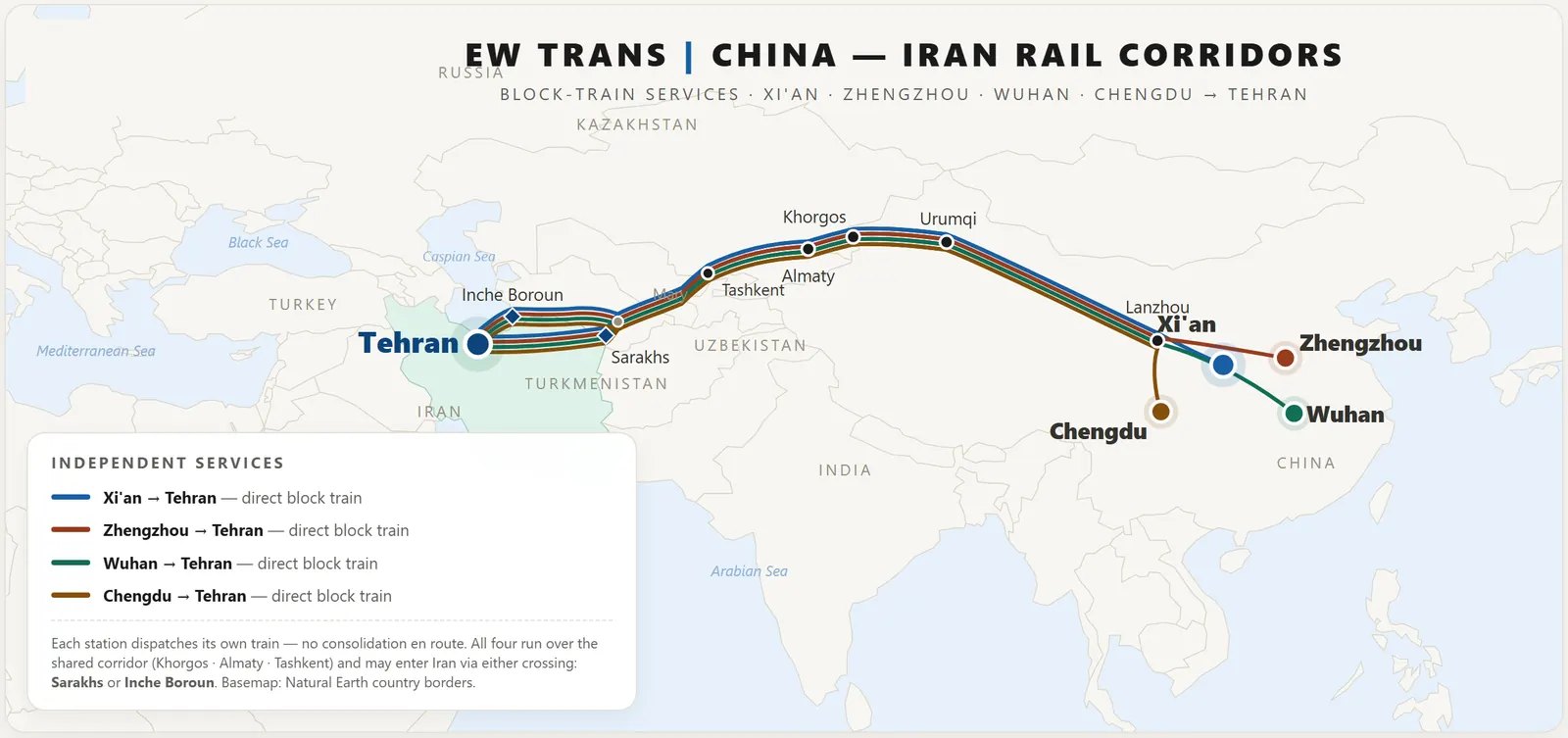
Cargo is first consolidated at a Chinese rail hub — Xi-an, Yiwu, Zhengzhou, Chengdu, Chongqing and Changsha are the established origins — before the international leg begins. From there the block train follows a fixed sequence:
- Exit from China: Khorgos or Alashankou on the Xinjiang border, crossing into Kazakhstan.
- First gauge change: China's 1,435 mm standard gauge meets the 1,520 mm broad gauge used across Central Asia. Containers are transshipped, or bogies are exchanged.
- Transit: Kazakhstan and Turkmenistan on a through rail waybill.
- Entry into Iran: Sarakhs in the north-east, the principal rail gateway, or Incheh Borun further west depending on routing and border conditions.
- Second gauge change: back onto Iranian standard gauge for the domestic run.
- Destination: Aprin dry port near Tehran, with onward domestic rail or road delivery to Isfahan, Mashhad, Tabriz and other cities.
Total distance is a little over 10,400 kilometres, and the corridor forms the southern arm of the middle corridor — the Eurasian rail network that links China to Europe and the Gulf without crossing Russia. Three structural facts explain most of the variance in transit time: two gauge changes, several national border clearances, and train frequency at the origin station. All three are covered in more depth on the China Iran railway page and the Sarakhs border crossing page.
4. Transit time and cost: rail, sea and road compared
Two quotes are only comparable when they cover the same scope. The table below compares the three overland and maritime options on the same door-to-door basis.
| Mode | Touches Hormuz | Typical door-to-door transit | Cost position | Main risk |
|---|---|---|---|---|
| Sea to Bandar Abbas | Yes | 30 to 40 days plus inland leg | Lowest base rate, before surcharges | Waterway security, war-risk surcharge, schedule postponement |
| Rail, full container | No | 15 to 25 days | Mid; above sea base rate, well below air | Border queues, gauge change, origin station frequency |
| Rail from Xi-an via Caspian (Aktau–Anzali) | No | 25 to 40 days | Mid | Caspian ferry schedule |
| Road and TIR | No | 15 to 20 days | Above rail | Single-vehicle capacity, road conditions |
Read the table with one rule in mind: the sea option looks cheapest only in its base-rate column. Once war-risk cover and risk surcharges are priced in — and once a fortnight of delay is valued against a delivery commitment — the rail freight rate is frequently the more economical choice on a door-to-door basis. The comparison is set out in more detail on the China to Iran sea freight and Trans-Caspian corridor pages.
5. Which shipments should move now, and which can wait
Not every consignment needs re-planning this week. Three categories should be assessed first.
| Shipment | Why it is exposed | What to do |
|---|---|---|
| Booked and waiting to load for Iran | If the vessel is re-assigned or postponed, the loading date slips and every downstream production plan moves with it | Confirm vessel and voyage with your forwarder today; price the rail alternative before you need it |
| Firm delivery dates with penalty clauses | Delay under a contract with liquidated damages costs far more than the freight differential | Work backwards from the delivery date and reserve a rail slot now |
| High-value or moisture-sensitive goods | Drifting containers, water damage and long delays all translate directly into cargo loss | Check cover and deductible, and price a sealed overland option |
| Bulk, low-value, no fixed date | Least exposed; schedule flexibility is worth more than the rate differential | Watch sea quotations and decide later |
6. Documents, HS codes and customs clearance in Iran
The document set on the rail lane is short but unforgiving: commercial invoice, packing list, rail waybill, certificate of origin and insurance certificate. Certain product groups additionally require import registration or a compliance certificate before the goods may enter the Iranian market.
Three rules save the most time, in our experience.
- The HS code is settled before departure, not at the border. The customs classification fixes both the import duty rate and the tax base, so a code that is decided late is a code that will be disputed. Every document — invoice, packing list, waybill, certificate of origin — must agree on the consignee name, the goods description and the code. A single mismatch is enough to hold a container.
- Clearance is prepared before arrival. The broker should be able to file as soon as the waybill is released, not days later. On a corridor with two gauge changes, a container that is cleared on arrival gains back most of the time it lost at the border.
- Regulated goods are flagged at booking. Batteries, chemicals, liquids, powders, magnetised items and anything classified as dangerous cargo are subject to carrier acceptance rules that have to be settled before the box is loaded, not after. Our China to Iran rail freight service page and the Iran DDP service page both spell out the acceptance conditions.
7. Door to door, DDP, and who pays the duty
Terminal-to-terminal pricing leaves clearance, duty and inland trucking with the consignee. A delivered-duty-paid arrangement hands the whole chain to one party: factory collection in China, export declaration, the rail leg, Iranian import clearance, payment of duty and value added tax, and delivery to the final address.
The difference between DDP and DAP sits entirely in the tax line — under DDP the seller carries duty and import tax, under DAP the buyer does. The two are frequently confused in quotations, so it is worth deciding which one you want before the price is fixed. For importers without a licensed broker in Iran, or those who would rather not manage the duty payment in a second currency, the delivered basis removes the largest source of surprises at the destination end. On this lane a single freight forwarder normally carries the whole chain, from factory collection in China to delivery inside Iran, so the scope written into the quotation matters more than the headline number.
8. Frequently asked questions
Is the Strait of Hormuz closed to commercial shipping?
No official closure has been confirmed. Published reporting shows transit is disrupted and that volumes through the Strait have fallen sharply, and vessels have been advised to exercise caution. Whether a particular shipment should still sail depends on its delivery sensitivity and on the operator's current rotation. The prudent approach is to prepare a land alternative in parallel rather than wait for the sailing to be confirmed.
Is China to Iran rail freight affected by the Hormuz incident?
Not directly. The rail corridor enters Iran from the north-east through Sarakhs or Incheh Borun and never passes the Strait of Hormuz, so the security event and the rail route do not overlap. The indirect effect runs the other way: disruption at sea increases demand for rail space, which is why slots on the Xi-an route have tightened and rates have risen.
How long does rail freight from China to Iran take?
Between 15 and 25 days door to door in most months. Transit is built from six stages — consolidation, China exit, first gauge change, Central Asian transit, Iranian entry and the second gauge change, and finally Aprin terminal, clearance and delivery. Each stage has its own queue logic, which is why a quoted single figure should always be read as an ideal case. When planning a delivery date, budget the upper bound.
What does a 40ft container cost on the China–Iran rail route?
Around USD 7,000 for a 40ft unit at present, roughly 40 per cent above pre-crisis levels, with demand exceeding available slots on some departures. The rate depends on the origin station, the equipment type (20GP or 40HQ), the commodity and its classification, the season, and whether the price covers the destination side. A terminal-to-terminal rate and a delivered-duty-paid rate are not comparable numbers.
Can I ship less than a container load to Iran by rail?
Yes. LCL, or groupage, shares a container with other shippers and is charged per cubic metre or per revenue tonne, whichever is greater. It suits consignments under roughly 15 cubic metres. Groupage is slower because the box cannot depart until it is full, so the key is to align your ready date with the fixed departure schedule. Our LCL groupage service from Xi-an to Tehran covers this option.
Can I combine rail with sea freight to reduce risk?
Yes, and most importers do. The usual pattern is rail for the regular programme and sea for cargo that can wait, with the trans-Caspian route (rail to Aktau, ferry to Anzali, rail onward) as a third path that avoids both the Strait and the southern border crossings. Splitting a programme across two corridors means no single event at one chokepoint can stop all of your supply.
Who is responsible for Iranian customs clearance and import duty?
It depends on the Incoterm and on the scope of the quotation. On a DAP basis the consignee clears and pays; on DDP the forwarder does. If you have your own licensed broker in Iran we can quote terminal to terminal; if you prefer a single invoice, we run import clearance, duty and tax payment and final delivery. The boundary is fixed before booking, not after the container arrives.
Does war-risk insurance cover a mine strike?
Standard marine cargo cover usually excludes war risk; mine strikes fall within the war-risk category and require a specific extension. Cargo already at sea should have its cover verified with the insurer immediately, and cargo not yet shipped should treat the insurance question as part of the booking decision. On the rail lane the risk profile is different, which is one reason some importers are re-allocating cargo rather than paying for extended cover.
If you are holding a shipment for Iran and want to know whether to keep it on the water or move it overland, send us the commodity, the volume, the pick-up city in China and the delivery address in Iran. We will come back with a rail rate, a realistic transit window and a routing, so you can compare it against the sea quotation on the same door-to-door basis.
Related pages
- China to Iran rail freight (FCL) — the main overland lane when the Strait is disrupted
- China to Iran sea freight (Bandar Abbas) — sailing schedules and surcharge context
- China to Iran road freight and TIR — Khorgos exit and flexible border switching
- Sarakhs border crossing — the principal rail gateway into Iran
- Incheh Borun border crossing — the north-western all-rail entry
- Aktau to Anzali Caspian route — the trans-Caspian northern corridor
- Is there a railway from China to Iran — corridor structure and gauge change points
- Trans-Caspian corridor — multimodal routing that avoids the Strait
- LCL groupage from Xi-an to Tehran — the door-to-door option for smaller lots
- Rail vs sea vs air: transit time and cost — the comparison before you choose
- Iran DDP delivered-duty-paid — who carries duty and tax