
The Trans-Caspian route, also called the Middle Corridor, has been asked about more and more in the last two years. Most of the questions come down to one thing: how it actually runs in 2026, whether the sailings are steady, and whether it is worth using to sidestep congestion at the land border crossings. This article follows the real dispatch order and breaks it into four handovers.
1. How the Trans-Caspian route runs: four handovers
It is not a single railway from China to Iran but a relay of rail and sea: first the domestic rail leg out of China, then to Aktau on the eastern shore of the Caspian, then a transhipment inside the port onto a Caspian barge or ro-ro vessel, then across to Anzali on the Iranian side, and finally by rail into Tehran.
| Leg | From and to | Typical duration | Key point |
|---|---|---|---|
| Leg one | Departure station in China to Aktau | About 10 to 15 days | Exit border and rail passage through Kazakhstan |
| Leg two | Transhipment inside the port of Aktau | 2 to 5 days | Port lifting and the barge or ro-ro berth |
| Leg three | Caspian barge or ro-ro to Anzali | 3 to 6 days | Calling schedule and sea conditions |
| Leg four | Anzali to Tehran | 2 to 4 days | Connection to the rail network inside Iran |
Added together, the four legs normally land between about 22 and 35 days. It adds one sea crossing compared with a fully overland route, but it skips one congested land border crossing. The route is described in fuller detail at the Trans-Caspian route (Aktau to Anzali).
2. Ports of call and how regular the sailings are
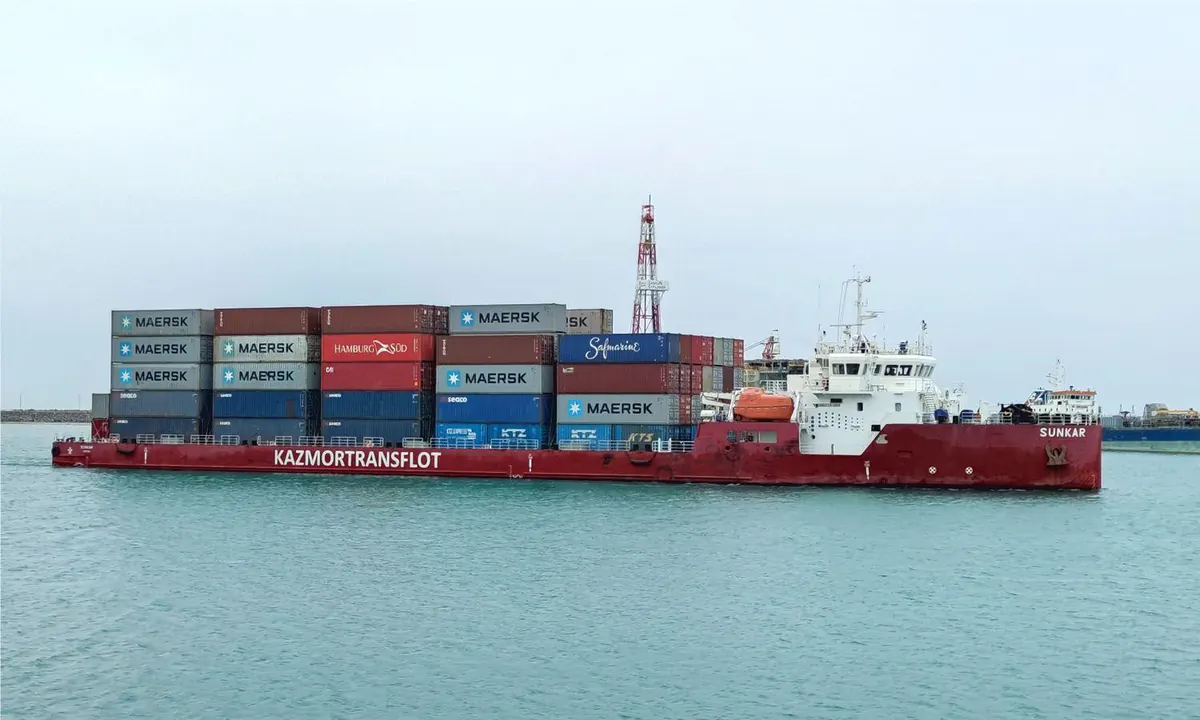
The Caspian leg does not have a vessel every day, and the regularity of the schedule is the precondition for choosing this route. The main ports of call and their roles are as follows.
| Port | Location | Role |
|---|---|---|
| Aktau | Eastern shore of the Caspian (Kazakhstan) | Main load port, with fairly complete transhipment facilities inside the port |
| Anzali | South-western shore of the Caspian (Iran) | Main discharge port, connecting to the rail network inside Iran |
| Other Caspian ports | Eastern and western shores | Used as alternative calls depending on the current service pattern |
On timing, the Caspian barges and ro-ro vessels usually sail at fixed intervals rather than daily, and they are pushed back when there are storms or when volume concentrates. The pattern is a few sailings a week, not a vessel every day, so a booking must be counted backward from the nearest sailing rather than estimated from an average transit time. The service and the connection details are set out at the Aktau to Anzali service.
3. Transhipment inside the port and the peak-season queue
Transhipment inside the port of Aktau means lifting containers off the rail flat wagons onto the vessel, or the reverse. This step happens inside the port and involves the transfer of title, port charges and waiting for a berth. It is the leg of the whole route that most needs buffer time built around it.
In peak season, cargo concentrates at the port and the berths and lifting equipment come under pressure at the same time, so the in-port wait can stretch from two or three days to about a week. This leg is not under the shipper control and can only be avoided by booking the vessel early and dispatching off-peak. Treating the in-port transhipment as a separate stage with its own buffer is the key to using the Trans-Caspian route without tripping up.
4. Which cargo suits the Caspian crossing
The Trans-Caspian route is not a universal option; it has a clear set of suitable cargo types, and choosing the wrong cargo turns the advantage into a burden.
| Cargo type | Suitable | Reason |
|---|---|---|
| General cargo and light industrial goods | Suitable | Not on an extreme deadline, and willing to trade one transhipment for a steadier corridor |
| Mechanical and electrical equipment | Fairly suitable | The cargo inside the box is stable, so the transhipment risk is manageable |
| Oversized or overweight pieces | Not suitable | In-port lifting limits are many and the ro-ro arrangement is complex |
| Very high value urgent cargo | Not advised | One extra sea crossing makes the chain longer |
In one line: it suits cargo whose owner is willing to accept one extra transhipment in exchange for a corridor that is relatively uncongested. To see the whole set of China to Iran options first, look at China to Iran rail freight (FCL), then judge whether the Trans-Caspian crossing is the right one.
5. What it is worth when the land borders are congested
Its core value is not that it is faster but that it divides the load. When the traditional land crossings concentrate traffic and queues grow, the Trans-Caspian route moves cargo off the congested land border and takes the pressure off that leg with a Caspian vessel.
So the question is not how many days faster it is than the overland route, but whether the land crossings are congested at the time. When the borders are flowing, the overland route is more direct; when the borders are tight, one extra sea crossing can actually save time. This is also why keeping both corridors open has value.
6. How to get the current schedules and transit times
The transit time on this route depends heavily on the current sailing schedule and port conditions, and a general figure can only serve as a reference.
Get current rates and transit times
Send us the goods name, the number of packages, weight and volume, the city of origin and the destination. We will prepare a comparison from the current Aktau loading schedule, the Caspian service and the onward connection in Iran, showing both the rate and the transit estimate with a validity date.
Frequently asked questions
How many days does the Trans-Caspian route take?
The four legs normally add up to about 22 to 35 days. It adds one sea crossing compared with a fully overland route, but it can avoid the queue at the land border crossings. The exact figure depends on the current sailing schedule, so it is best to count backward from the nearest sailing.
How often do the Caspian vessels sail?
The barges and ro-ro vessels usually sail a few fixed times a week rather than every day, and they are pushed back by storms or concentrated volume. When booking, count backward from the nearest sailing instead of estimating from an average, otherwise a whole sailing interval can be left out of the plan.
What cargo is not suited to the Trans-Caspian route?
Oversized and overweight pieces, and very high value urgent cargo. The former is limited by in-port lifting and the ro-ro arrangement, which makes handling complex; the latter gains no time advantage from an extra sea crossing and a longer chain. Both are better suited to the overland or road route.
Related lanes
- Trans-Caspian route (Aktau to Anzali) — the four handovers and how the corridor works
- Aktau to Anzali service — ports of call and sailing patterns on the Caspian leg
- China to Iran rail freight (FCL) — the full set of corridor options
- Sarakhs border crossing — the land border counterpart for comparison