
The Middle Corridor and the traditional northern route are the two main ways to move rail freight from China to Iran today. The question shippers ask most is which one to take. There is no single answer, because the choice has to be made stage by stage. This article aligns the two routes in one table, then gives a judgment by commodity and deadline.
1. Telling the two routes apart
The northern route uses the land border crossings through Kazakhstan and Turkmenistan, completing every transhipment on dry land and never touching water. The Middle Corridor instead puts the cargo onto a Caspian vessel at Aktau in Kazakhstan, runs to Anzali in Iran, and then enters Tehran, with one sea crossing in the middle.
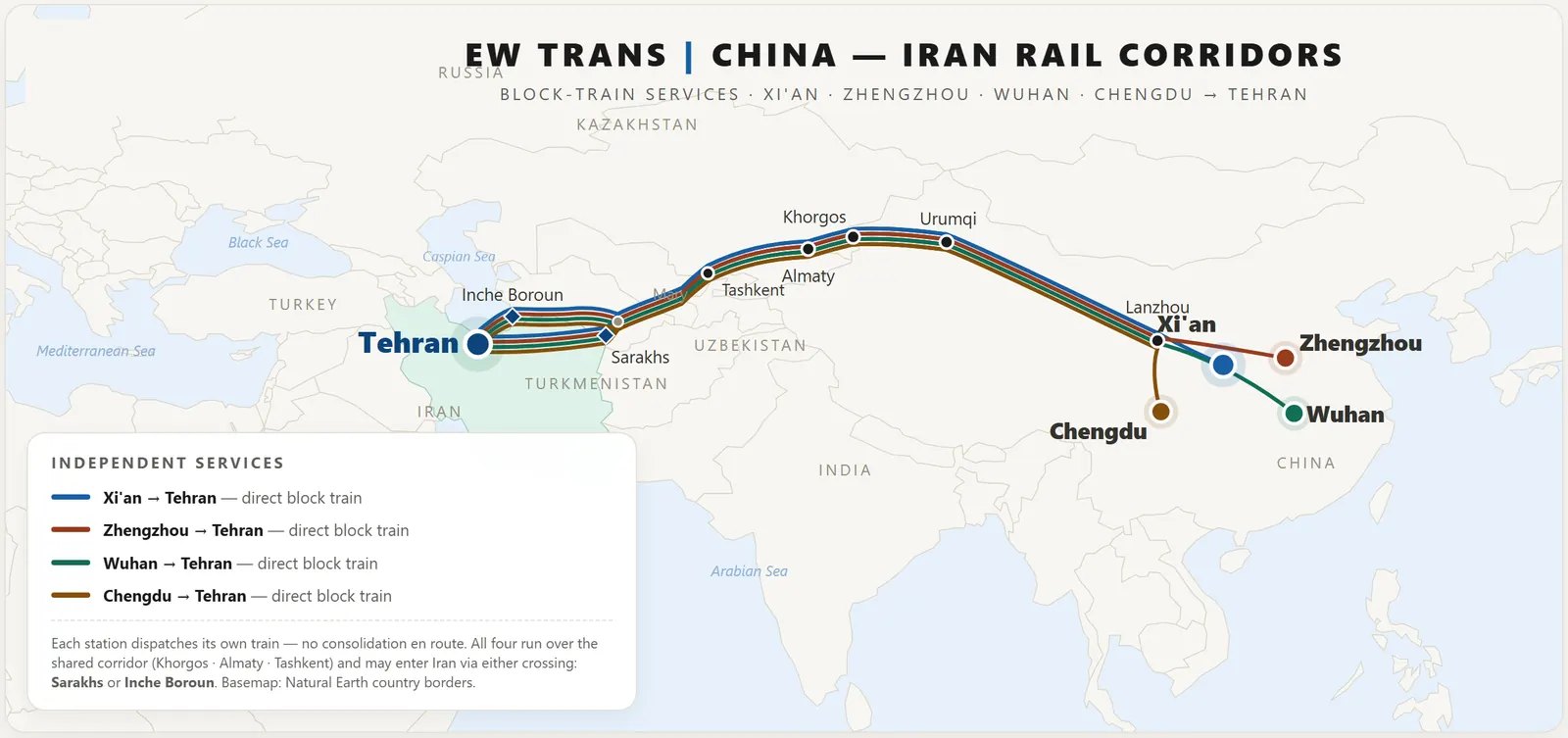
Both routes share the same starting point at a departure station in China and the same general end point inside Iran. The difference is concentrated in how the middle is crossed. The full set of countries each route passes through is laid out at the China to Iran railway line and its transit countries.
2. The two routes compared stage by stage
Place the two routes side by side, stage by stage, and the difference becomes clear. The table below shows the normal case; the current border and sailing conditions always govern in practice.
| Stage | Middle Corridor (Trans-Caspian) | Traditional north (land border) |
|---|---|---|
| Exit border | Toward Kazakhstan | Toward Kazakhstan |
| Number of transhipments | More, including an in-port transhipment and a loading onto ship | Fewer, mainly gauge changes |
| Transit countries | Kazakhstan, Caspian shipping, Iran | Kazakhstan, Turkmenistan, Iran |
| Cargo goes on a ship | Yes (Caspian barge or ro-ro) | No |
| Transit-time stability | Driven by sailing schedule and port conditions | Driven by congestion at the land border |
| Cost per container | Higher, with one extra sea crossing | Relatively lower |
| Cargo types suited | General cargo, light industrial goods, machinery | General cargo, heavy goods, large volumes |
The point to hold on to is two variables: the Middle Corridor fears the sailing schedule, and the northern route fears the border. Whichever side is tight in the current period, divert toward the other. The details of the Caspian leg are set out at the Trans-Caspian route (Aktau to Anzali).
3. Choosing by commodity and deadline
Put the commodity and the deadline together and the choice becomes clearer. The table below gives a direction for the judgment, not an absolute conclusion.
| Situation | Suggested corridor | Reason |
|---|---|---|
| Large volume of general cargo, loose deadline | Northern route | One fewer transhipment, and the cost per container is relatively lower |
| General cargo, medium deadline | Whichever is smoother now | Both work; compare the current border and sailing conditions |
| Higher value, avoiding a long chain | Northern route | Fewer links, so damage and connection risk are lower |
| During congestion at the northern border | Middle Corridor | Uses a Caspian vessel to take the pressure off the land border |
| Oversized or overweight pieces | Northern route | In-port lifting and ro-ro limits are many, so it does not fit |
The main entry crossings on the northern route cluster around Sarakhs, and the handling there is described at the Sarakhs border crossing. When judging, set the deadline first, then check which corridor is under less pressure in the current period, and only then compare the price.
4. Why keeping both corridors open matters
The two corridors are not substitutes but complements. Their congested periods usually differ: when the land border is under heavy pressure, the Caspian sailing schedule is not necessarily tight, and when the sailing schedule slips in peak season, the land route may be flowing relatively well.
For the shipper, the real value is having a choice. Whichever corridor is smoother in the current period is the one to route the cargo through; with only one available, a single problem leaves you waiting with no alternative. The value of keeping both open is not that one is always better, but that when either one fails, the other can catch the cargo.
In practice, a fairly steady approach is to route the regular batches by the northern route and to reserve the Middle Corridor for batches that need a fallback option, or for periods when the land border is congested. This protects the cost base while keeping the emergency capacity.
5. Bringing the choice down to the current period
Corridor choice is not fixed once and for all; adjusting it to current conditions is the sensible way to work.
Get current rates and transit times
Send us the goods name, the number of packages, weight and volume, the city of origin and the destination. We will prepare a comparison from the current border conditions, sailing schedules and rates across both corridors, showing the rate and the transit estimate with a validity date, so you can compare them side by side.
Frequently asked questions
Which is faster, the Middle Corridor or the northern route?
There is no fixed answer. When the northern route is flowing it has fewer links and is usually faster; when the northern border is congested, the Middle Corridor is steadier. The judgment rests on the current border and sailing conditions, not on the nominal speed of the corridor itself.
How different is the number of transhipments?
The Middle Corridor has one extra in-port transhipment and one extra loading onto ship compared with the northern route, so the chain is longer. The northern route relies mainly on gauge changes and never touches water. For this reason the northern route is friendlier to oversized and overweight pieces, while the Middle Corridor suits standard container general cargo.
Why not keep only one corridor?
The two corridors are congested at different times, so keeping both is what gives the ability to divert. With only one, a single problem leaves no alternative and the cargo simply waits. The value of keeping both is that they back each other up.
Related lanes
- Trans-Caspian route (Aktau to Anzali) — how the Middle Corridor runs and how often it sails
- China to Iran railway line — the countries crossed by both routes
- Sarakhs border crossing — the main entry point on the northern route
- China to Iran rail freight (FCL) — the full range of corridor options